Learn to distinguish normal sweating from excessive sweating that may require medical evaluation.

Sweating is a natural bodily response. It helps us regulate our temperature when the weather is hot, when we exercise or when we experience a stressful situation.
However, some people sweat much more than necessary, even when they are resting or the temperature is comfortable. When this excessive sweating occurs repeatedly and begins to interfere with everyday life, it may be hyperhidrosis.
But how can you tell whether you actually have hyperhidrosis or simply sweat more than other people?
What is hyperhidrosis?
Hyperhidrosis is a condition characterised by sweat production that exceeds what the body needs to regulate its temperature.
It can affect different parts of the body, although the most commonly affected areas are:
- Hands.
- Armpits.
- Feet.
- Face.
- Scalp.
In some cases, the sweating is so severe that the hands remain wet, visible sweat marks appear on clothing, or the person needs to dry themselves continuously.
It is not merely an aesthetic concern. Hyperhidrosis can affect work, studies, personal relationships and many everyday activities.
What is the difference between sweating and having hyperhidrosis?
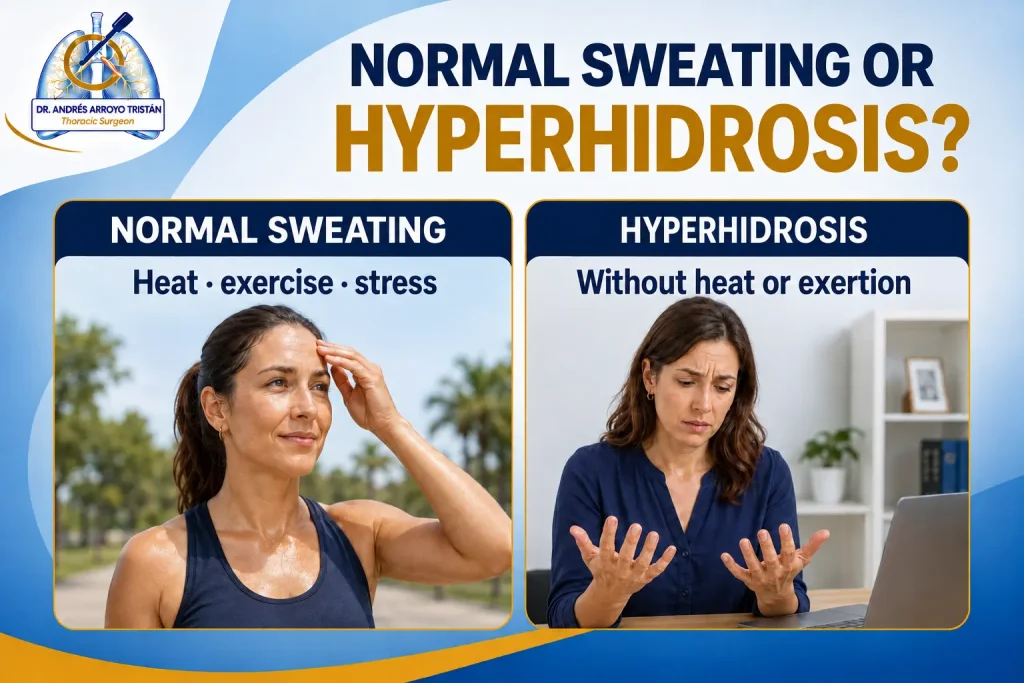
Normal sweating usually occurs in response to an identifiable cause, such as heat, physical activity, fever or a temporary moment of nervousness.
Once that stimulus disappears, the body gradually reduces sweat production.
With hyperhidrosis, however, sweating can occur even when it is not hot and without any physical exertion. It may also be much more intense than would be expected in that situation.
For example, a person may be sitting, working at a computer or having a relaxed conversation and notice that their hands begin to become wet.
Although nervousness can make the problem worse, primary hyperhidrosis should not simply be confused with feeling nervous. In many cases, sweating occurs without any clear emotional trigger.
Signs that may indicate primary hyperhidrosis
There is no single test that can diagnose hyperhidrosis at home. However, certain features may suggest primary hyperhidrosis.
- It began during childhood or adolescence
Primary hyperhidrosis usually develops at an early age.
Many people remember experiencing difficulties at school, such as making the paper wet when writing, avoiding shaking hands or feeling embarrassed by sweat marks on their clothing.
Other family members may also have similar symptoms, suggesting that there could be a family predisposition.
- It affects both sides of the body
Sweating usually follows a bilateral and relatively symmetrical pattern.
For example:
- Both hands.
- Both armpits.
- Both feet.
- Both sides of the face.
When excessive sweating affects only one side of the body or occurs very unevenly, further assessment is recommended to rule out other possible causes.
- It occurs frequently
We are not talking about sweating heavily on a particularly hot day. To suspect hyperhidrosis, the episodes must recur over several months.
The criteria used to guide diagnosis include visible focal sweating for at least six months, with no apparent cause and with frequent episodes.
- It interferes with everyday life
The amount of sweat is not the only factor that should be assessed. It is also important to consider how much the problem affects the person’s life.
Hyperhidrosis can make everyday activities difficult, such as:
- Writing.
- Using a mobile phone.
- Holding tools.
- Driving.
- Shaking hands.
- Choosing certain clothes.
Some people carry spare clothes, dry their hands continuously or avoid certain situations so that others do not notice the sweating.
When sweating forces someone to change their habits, limits their activities or causes insecurity, it is advisable to seek medical assessment.
- It stops during sleep
A common feature of primary hyperhidrosis is that excessive sweating usually stops while the person is asleep.
Frequently waking up with soaked pyjamas or bedsheets is not the most typical pattern of this condition. In such cases, it is advisable to investigate whether there may be another cause.
Night sweats do not necessarily indicate a serious problem, but they should be assessed by a doctor, especially if they occur without explanation or are accompanied by fever, weight loss or other symptoms.
Primary hyperhidrosis and secondary hyperhidrosis
Not all forms of excessive sweating have the same cause. Before considering any treatment, it is important to distinguish between primary and secondary hyperhidrosis.
Primary hyperhidrosis
Primary hyperhidrosis is not caused by another known medical condition. It is associated with excessive activity in the nervous system signals that stimulate the sweat glands.
It usually has the following characteristics:
- Begins at an early age.
- Affects specific areas.
- Follows a bilateral pattern.
- Occurs frequently.
- Stops during sleep.
- Possible family history.
The most commonly affected areas are the hands, armpits, feet and face.
Secondary hyperhidrosis
Secondary hyperhidrosis occurs as a result of another medical condition, a change in the body or the use of certain medications.
It may be associated with:
- Hormonal changes.
- Thyroid problems.
- Diabetes.
- Menopause.
- Certain infections.
- Certain medications.
Unlike primary hyperhidrosis, it may affect large areas of the body, begin suddenly in adulthood or also occur at night.
For this reason, before confirming the diagnosis, we need to know when the symptoms began, which areas are affected and whether there are any other associated signs.
When should you seek medical advice?
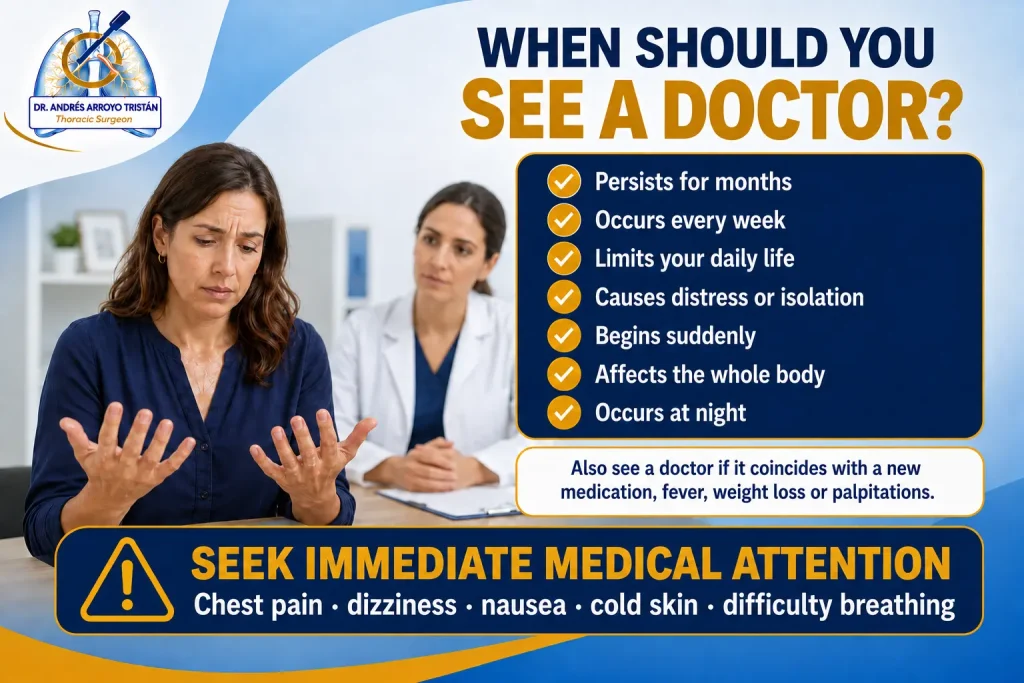
It is advisable to seek medical assessment when sweating:
- Persists for several months.
- Occurs every week.
- Limits everyday activities.
- Causes distress or social withdrawal.
- Begins suddenly.
- Affects the entire body.
- Also occurs at night.
You should also seek medical advice if it coincides with starting a new medication or is accompanied by fever, weight loss, palpitations or other symptoms.
If severe sweating occurs alongside chest pain, dizziness, nausea, cold skin or difficulty breathing, immediate medical attention should be sought.
How is hyperhidrosis diagnosed?
Diagnosis begins with a clinical consultation. We need to know when the problem started, which areas are affected, how often it occurs and how it impacts everyday life.
We also assess whether there is night-time sweating, a family history, previous medical conditions or medications that may be related.
In cases consistent with primary hyperhidrosis, diagnosis is usually based mainly on the clinical assessment. If the pattern is not typical, blood tests or other investigations may be requested to rule out a secondary cause.
There are also tests that help identify the areas producing the most sweat and assess the severity of the problem, such as the iodine–starch test.
Can hyperhidrosis be treated?
Yes. Treatment should be tailored to the affected area, the severity of the sweating and its impact on each patient’s life.
Available options include:
- Specific antiperspirants.
- Medications.
- Iontophoresis.
- Botulinum toxin.
- Surgical treatment.
In selected patients with severe primary hyperhidrosis affecting the hands or armpits, particularly when other options have not achieved sufficient improvement, we may consider surgical treatment using video-assisted thoracoscopic sympathicotomy.
Surgery is not suitable for everyone or for every type of excessive sweating. Before recommending it, it is essential to confirm the diagnosis, rule out possible secondary causes and clearly explain its benefits, limitations and potential side effects.
We can assess your case
If excessive sweating affects your hands or armpits and is impacting your personal, social or professional life, we can assess your case on an individual basis.
During the consultation, we will evaluate the type of sweating, the areas affected, its severity, the treatments you have tried and how it impacts your daily life.
With this information, we can determine whether it may be primary hyperhidrosis, whether other causes need to be ruled out and which treatment options may be suitable for you.
For more information or to book a consultation, visit www.andresarroyotristan.com.