Guide for High-Risk Smokers and Former Smokers
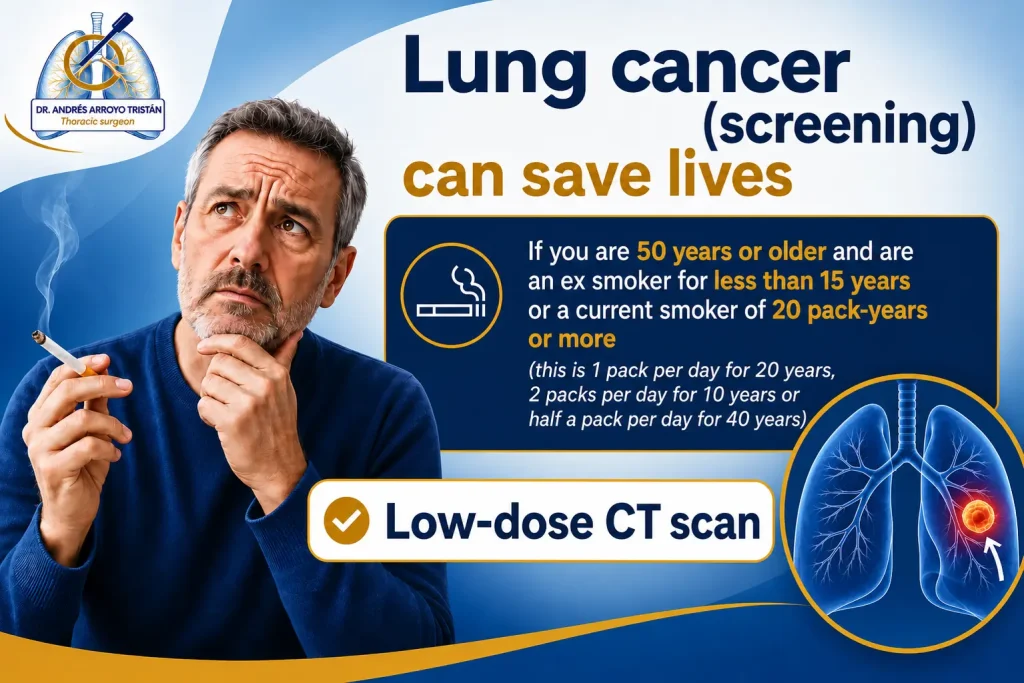
Lung cancer screening using low-dose CT can help detect certain lung tumors before they cause symptoms, when they may still be at an early stage.
It is not recommended for the general population. However, in people at high risk of developing lung cancer—mainly because of their age and smoking history—having regular low-dose chest CT scans can help achieve an earlier diagnosis and reduce mortality associated with the disease.
But who should consider this screening? How many years of smoking history are relevant? Is it also recommended for former smokers? And what happens if a pulmonary nodule is found?
What Is Lung Cancer Screening?
Lung cancer remains one of the leading causes of cancer-related death. The problem is that, in many cases, by the time it causes symptoms, the disease is already at an advanced stage. For this reason, in people at high risk, the strategy is not to wait for symptoms such as cough, pain, or shortness of breath to appear, but rather to look for the tumor before it causes any symptoms.
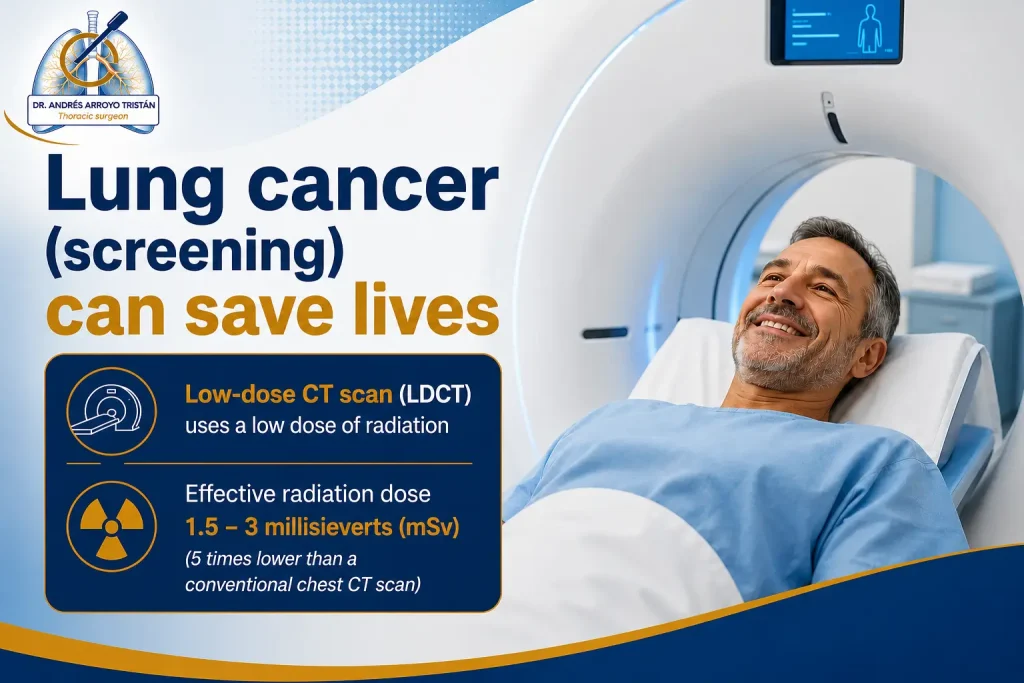
This is known as screening. At present, the test that has shown benefit is low-dose computed tomography of the chest, known as low-dose CT or LDCT. It is not the same as having a conventional CT scan for any reason: screening uses protocols specifically designed to obtain images of the lungs with a reduced radiation dose.
Why Isn’t a Chest X-Ray Enough?
The landmark studies that changed lung cancer prevention are the NLST, conducted in the United States, and the NELSON trial, conducted in Europe. In the NLST, screening with low-dose CT reduced lung cancer mortality by approximately 20% compared with chest X-ray. The European NELSON trial confirmed this benefit and showed an approximate 24% reduction in lung cancer mortality at 10 years in men.
The reason is simple: CT can detect much smaller lung lesions than a chest X-ray. In the NLST, around 70% of cancers detected by CT were stage I, compared with 56.7% in the chest X-ray group. Detecting cancer while it is still small increases the chances of using treatments with curative intent.
Who Should Consider a Low-Dose CT Scan?
Current recommendations agree on one key point: low-dose CT screening should not be offered to the entire population, but rather to people whose risk of developing lung cancer is sufficiently high.
The broader U.S. recommendations—such as those from the USPSTF, the American Cancer Society, and the NCCN—generally set the threshold at around age 50 and a smoking history of 20 pack-years. The USPSTF recommends annual low-dose CT screening for adults aged 50 to 80 years with at least a 20 pack-year smoking history who currently smoke or who quit within the past 15 years.
In Spain, the CASSANDRA project uses as a reference adults aged 50 to 75 years, with at least a 20 pack-year smoking history and fewer than 15 years since quitting smoking, provided that the person is asymptomatic and would be eligible for curative treatment if lung cancer were detected.
These figures are useful for guidance, but they do not replace an individual medical assessment. Other factors may also influence risk, including a family history of lung cancer, exposure to radon, asbestos, silica or other carcinogens, COPD, or pulmonary fibrosis.
What Does a 20 Pack-Year Smoking History Mean?
It is a way of measuring cumulative tobacco exposure. It is calculated by multiplying the number of packs smoked per day by the number of years a person has smoked.
For example:
• 1 pack per day for 20 years = 20 pack-years.
• 2 packs per day for 10 years = 20 pack-years.
• Half a pack per day for 40 years = 20 pack-years.
Therefore, what matters is not only how much a person currently smokes, but also the total amount of tobacco exposure accumulated over their lifetime.
What If I’ve Already Quit Smoking?
Quitting smoking is one of the best decisions you can make to reduce your risk of lung cancer, but the risk does not disappear immediately. For this reason, current recommendations also include certain former smokers.
As a general reference, the USPSTF considers people eligible for screening if they quit smoking less than 15 years ago. CASSANDRA also uses a 15-year threshold. Other European screening strategies may apply slightly different criteria, so the decision should always be individualized.
What Happens If the CT Scan Finds a Pulmonary Nodule?
Finding a pulmonary nodule does not mean that cancer is present. In fact, one of the main challenges of screening is that it can detect findings that require follow-up but ultimately prove to be benign.
Modern screening programs aim to reduce this problem by using structured protocols and assessing not only the size of the nodule, but also its volume, whether it is new and, most importantly, whether it grows over time. The approach used in the NELSON trial and incorporated into CASSANDRA relies on volumetric assessment and volume doubling time to determine when a CT scan should be repeated and when further testing is required.
Depending on the appearance and evolution of the nodule, follow-up may remain annual, the CT scan may be repeated after a few months, or additional tests such as PET-CT, biopsy, or multidisciplinary assessment may be necessary.
Does Lung Cancer Screening Have Risks?
Yes. And it is important to explain these risks before undergoing screening. Low-dose CT uses less radiation than a conventional CT scan, but it is not a radiation-free test. In addition, false positives, incidental findings and, in some cases, unnecessary additional tests may occur.
Studies have also identified the issue of overdiagnosis: some tumors may grow so slowly that they would never cause problems during a person’s lifetime. For this reason, screening should be carried out within an organized program, with radiologists and specialists experienced in interpreting and managing these findings, and with a clear follow-up pathway.
The goal is not to perform more tests, but to carefully select who should undergo screening and to respond appropriately when a lesion is detected.
Does Lung Cancer Screening Mean I Can Keep Smoking?
No. Screening does not replace quitting smoking. In fact, all current recommendations emphasize that quitting smoking remains the most important measure for reducing the risk of lung cancer and other tobacco-related diseases.
A high-quality screening program should use this opportunity to offer support for smoking cessation. CASSANDRA, for example, combines lung cancer screening with smoking cessation support and respiratory assessment. CT scans may also reveal emphysema, COPD, interstitial lung disease, or other smoking-related findings.
What Is the Current Situation in Spain?
Europe is moving towards organized lung cancer screening programs, but there is currently no single standardized protocol that is identical across all countries. In Spain, the CASSANDRA project is one of the most relevant initiatives studying how to implement a population-based lung cancer screening program using low-dose CT.
CASSANDRA is not simply about performing CT scans in smokers. Its approach integrates the identification of high-risk individuals, low-dose CT, structured management of pulmonary nodules, rapid diagnosis when necessary, respiratory assessment, and smoking cessation support. The project began its clinical pilot phase in 2023 and aims to provide evidence for the effective, safe, organized, and cost-effective implementation of lung cancer screening in Spain.
My Recommendation: Should I Have a Low-Dose CT Scan?
If you are aged 50 or older, have accumulated a smoking history of around 20 pack-years or more, currently smoke or quit smoking less than 15 years ago, you should undergo a medical assessment to determine whether you are a candidate for a lung cancer screening program.
If you are also asymptomatic and, if cancer were detected, would be eligible for treatment with curative intent, current evidence supports screening with low-dose CT.
There is an important distinction: if you already have suspicious symptoms—for example, coughing up blood, a cough that has changed or worsened, new-onset hoarseness, or unexplained weight loss—you should not wait to enter a screening program. In that case, the appropriate approach is to undergo a diagnostic evaluation.
Conclusion: if you belong to a high-risk group, my recommendation is that you be assessed for annual low-dose chest CT screening, always within an organized medical program and for as long as you remain a candidate for treatment with curative intent. At the same time, quitting smoking remains the most important preventive measure.
Main Sources
- NCCN Guidelines® Lung Cancer Screening, Version 1.2026.
- Screening for Lung Cancer. JAMA. 2021;325(10):962-970.
- De Koning HJ et al. Reduced Lung-Cancer Mortality with Volume CT Screening. N Engl J Med. 2020;382:503-513.
- Baldwin DR et al. ERS Technical Standard for a Comprehensive High-Quality Lung Cancer CT Screening Programme. Eur Respir J. 2023;61:2300128.
- 2026 Summary of Recommendations from the USA, Europe, and Spain/CASSANDRA. OpenEvidence and Elicit (AI) research document.
Editorial note: this text is intended for patient education and does not replace an individual medical assessment. Eligibility criteria may vary depending on the healthcare program and may be updated over time.