PREPARING BEFORE SURGERY, ACTIVELY PARTICIPATING DURING YOUR HOSPITAL STAY, AND CONTINUING RECOVERY AT HOME ARE ALL PART OF THE SAME PROCESS.
When a person is about to undergo surgery for lung cancer, it is natural for them to focus their attention on the procedure itself. However, recovery does not depend solely on what happens in the operating room. Physical and respiratory preparation before surgery, pain management, respiratory physiotherapy and early mobilization during hospitalization, and the continuation of exercises and physical activity after discharge are all part of the same perioperative process.
Respiratory physiotherapy in thoracic surgery is incorporated into modern recovery programs. SEPAR (Spanish Society of Pulmonology and Thoracic Surgery) has published a Manual of Respiratory Physiotherapy in Thoracic Surgery and emphasizes that measures to reduce respiratory complications begin before surgery, continue throughout hospitalization, and extend into the postoperative period. The European Society of Thoracic Surgeons also includes Fissios among its resources for thoracic surgery patients.
WHAT IS RESPIRATORY PHYSIOTHERAPY?
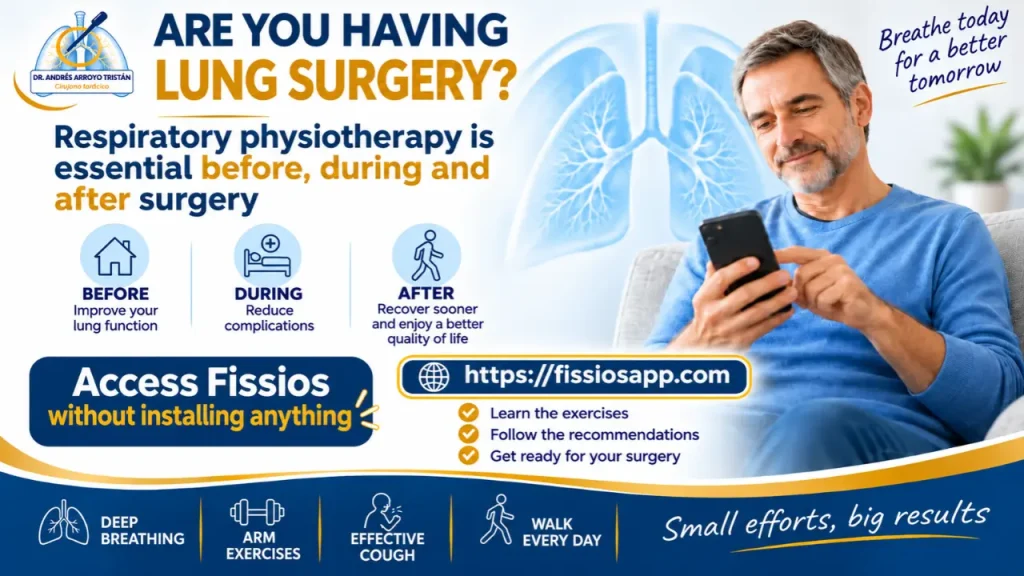
Respiratory physiotherapy should not be confused with simply using an incentive spirometer, commonly known as the “three-ball breathing device.” Respiratory physiotherapy is a broader program that combines learning effective breathing techniques, lung expansion exercises, airway secretion clearance, coughing techniques, physical activity, and progressive mobilization.
An incentive spirometer can be part of this program as a tool for performing slow, deep breaths, but it does not replace the other components. Similarly, Fissios is not physiotherapy itself; it is an application that helps patients learn, remember, and follow a structured program.
BEFORE SURGERY: LEARNING WHILE YOU STILL FEEL WELL
The period between the decision to undergo surgery and hospital admission provides an opportunity to prepare the patient. The aim is not to engage in excessive physical exertion, but to arrive for surgery already familiar with exercises that will be particularly useful afterwards.
The exercises included in Fissios cover correct sitting posture, nasal and mouth breathing control, abdominal-diaphragmatic breathing, lung expansion exercises, arm movements coordinated with breathing, airway secretion clearance techniques, incentive spirometry, voluntary and effective coughing techniques, as well as walking as a form of aerobic activity.
Learning these techniques beforehand offers a practical advantage: after surgery, when patients may experience pain, fatigue, chest drains, and greater difficulty concentrating, they will already be familiar with the exercises and can resume them when instructed by their healthcare team.
DURING HOSPITALIZATION: PAIN MANAGEMENT, BREATHING, AND MOBILIZATION
When we talk about physiotherapy “during” surgery, we are referring to the perioperative period and, particularly, recovery in hospital. Obviously, exercises are not performed while the patient is under anaesthesia. After waking up, pain can lead to shallower breathing and make coughing less effective. This is why adequate pain management is also important from a respiratory perspective.
When the patient’s clinical condition allows, breathing exercises, airway clearance techniques, and effective coughing are gradually resumed. Another essential element is added to this process: getting out of bed. Sitting up, standing, and gradually walking are all part of functional and respiratory recovery.
At this stage, the application can help patients remember what they have learned, but it must never replace the instructions provided by the surgeon, nursing staff, physiotherapist, or rehabilitation team. Chest drains, oxygen therapy, regional analgesia, cardiovascular status, or any postoperative complications may require temporary adjustments to the exercises.
AFTER HOSPITAL DISCHARGE, RECOVERY CONTINUES AT HOME
Being discharged from hospital does not mean that the recovery process is complete. At home, patients can continue performing the breathing exercises recommended by their healthcare team, use coughing techniques when necessary to clear airway secretions, and gradually increase walking and everyday activities.
The aim is not to rush recovery, but rather to avoid complete bed rest. The intensity of physical activity should increase gradually and be adapted to each patient’s individual condition. If significant shortness of breath, fever, noticeably worsening pain, dizziness, bleeding, or any other concerning symptoms occur, the application and exercises are not a substitute for medical assessment.
WHAT IS FISSIOS AND WHAT EVIDENCE SUPPORTS IT?
Fissios is a free application developed by a multidisciplinary team of thoracic surgeons, physiotherapists, and specialists in Physical Medicine and Rehabilitation. It includes 10 structured respiratory physiotherapy exercises and 40 perioperative recommendations.
Its development and evaluation are closely linked to Spanish scientific societies in thoracic surgery and pulmonology. The SEPAR Manual of Respiratory Physiotherapy in Thoracic Surgery includes Fissios among its e-health resources and identifies SEPAR and SECT as the scientific societies endorsing the application. In addition, the project has received funding from the SECT Foundation and a SEPAR research grant. A multicentre randomised clinical trial — the FPoC Trial — is also investigating Fissios as a complement to face-to-face respiratory physiotherapy.
The studies published so far are promising, but the evidence must be interpreted correctly. In a quasi-experimental study involving 393 patients, Fissios was used alongside an in-person respiratory physiotherapy programme, and the group using the application experienced fewer postoperative pulmonary complications and a shorter hospital stay. This does not mean that the application alone can replace physiotherapy, nor does it prove that Fissios was solely responsible for these outcomes.
HOW TO USE FISSIOS
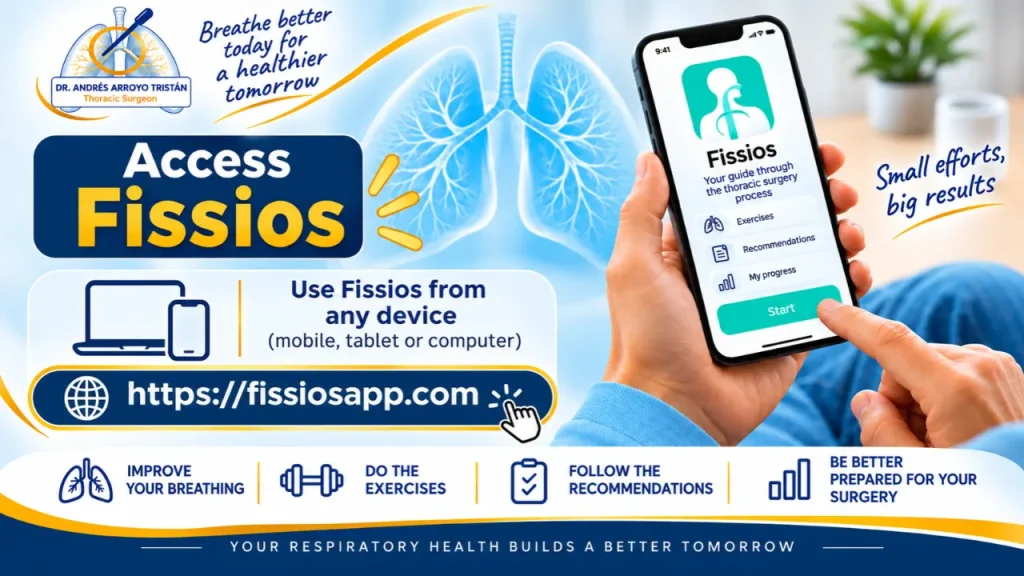
You can access Fissios through the browser on your mobile phone, tablet or computer, without installing the app.
- Go to fissiosapp.com.
- Enter your name.
- Enter your scheduled surgery date.
- View the preoperative exercises and recommendations.
- When the time comes, you’ll also find the postoperative recommendations for your stage of recovery.
Your surgery date helps Fissios show you the right content for each stage. Always follow your medical team’s advice.
HOW TO FOLLOW THE EXERCISE PROGRAM?
Fissios presents each exercise with text and images and includes a timer to guide patients through the exercises. The published programme follows this sequence:
– Basic position: 30 seconds.
– Nasal and mouth breathing: 30 seconds.
– Abdominal-diaphragmatic breathing: 10 repetitions.
– Lung expansion: 10 repetitions.
– Arm exercises coordinated with breathing: 10 repetitions.
– “Sigh and hug” technique to facilitate exhalation and airway secretion clearance: 10 repetitions.
– Incentive spirometry: 10 slow, deep breaths.
– Voluntary coughing manoeuvre: 3 repetitions.
– Effective coughing: 3 repetitions.
– Walking: 10 minutes in the published programme, adapted to the patient’s clinical condition and the instructions provided by their healthcare team.
These figures describe the structured exercise programme published for Fissios. They should not be interpreted as a universal prescription independent of clinical assessment. The frequency, intensity, and progression of the exercises must be adapted to each patient, particularly after surgery.
FISSIOS COMPLEMENTA AL EQUIPO SANITARIO
The value of an application like Fissios lies in empowering patients to take an active role in their recovery: learning before surgery, reinforcing that knowledge afterwards, and having an easy-to-use reference available on their phone. However, technology does not replace professional clinical assessment. Respiratory physiotherapy is part of a broader care programme that includes surgery, anaesthesia, pain management, nursing care, nutrition, smoking cessation when appropriate, and early mobilisation.
If you are going to undergo surgery for lung cancer, you can ask your surgeon when to start the programme and how to adapt it to your individual needs. Arriving for surgery already knowing what to do afterwards can make the postoperative period easier to understand and allow you to take a more active role in your recovery.
USEFUL LINKS AND RESOURCES
- Fissios on Google Play
- Fissios on the App Store
- Manual of Respiratory Physiotherapy in Thoracic Surgery · SEPAR
- Fissios · Patient Resource from the European Society of Thoracic Surgeons (ESTS)
- Fissios Implementation Study · PubMed
- Clinical Study of Fissios as an Adjunct to In-Person Physiotherapy · PubMed
- FPoC Trial · Ensayo clínico multicéntrico aleatorizado
- Fissios App Working Group · SECT