When an imaging test, such as an X-ray or CT scan, detects a lesion in the lung, further tests may sometimes be necessary to determine its nature.
One of the diagnostic tools we can use is a lung biopsy. However, it is important to clarify that not all lung lesions require a biopsy, and finding a nodule does not necessarily mean that cancer is present.
The decision to perform this procedure must be based on an individual assessment of each patient.
What Is a Lung Biopsy?
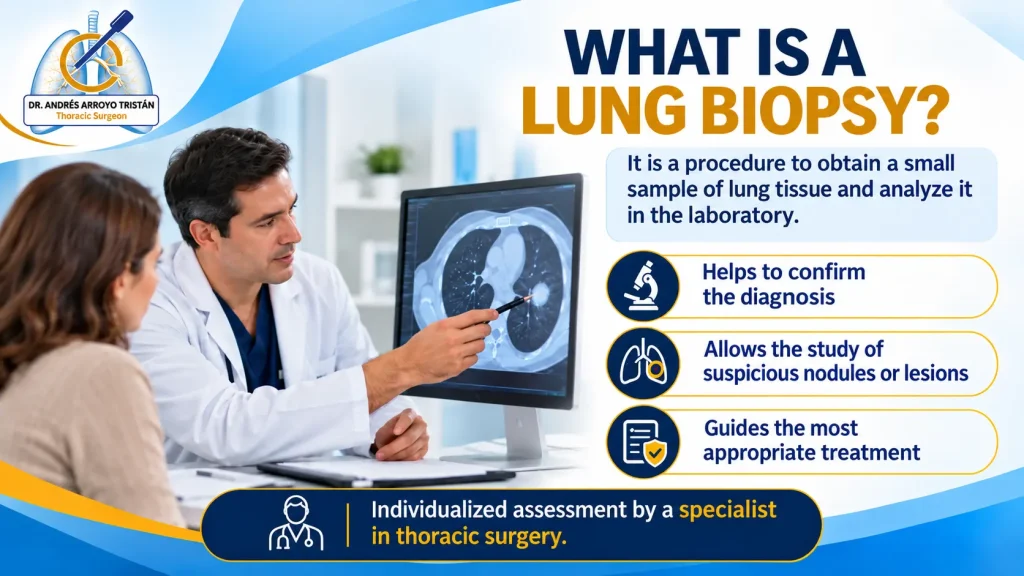
A lung biopsy is a procedure that allows us to obtain a small sample of lung tissue for laboratory analysis.
Its main purpose is to determine the nature of a lesion and help establish an accurate diagnosis.
Although it is frequently used when lung cancer is suspected, it may also be necessary to investigate certain inflammatory, infectious, or interstitial lung diseases.
In the case of lung tumors, analyzing the sample can help identify the type of cancer and provide relevant information to select the most appropriate treatment.
When Do We Recommend Performing a Lung Biopsy?
One of the most common situations is the detection of a lung nodule with suspicious characteristics on an imaging test.
To determine whether a tissue sample is necessary, we assess several factors:
The size and characteristics of the nodule.
Its growth or progression in previous imaging studies.
The patient’s medical history and risk factors.
The results of other diagnostic tests.
In some cases, the most appropriate option will be to monitor the nodule with periodic CT scans. In others, when the suspicion of malignancy is higher or we need to determine the nature of the lesion to decide on treatment, a biopsy may be indicated.
The key is to assess what information we need to obtain and how to obtain it with the lowest possible risk to the patient.
How Is a Lung Biopsy Performed?
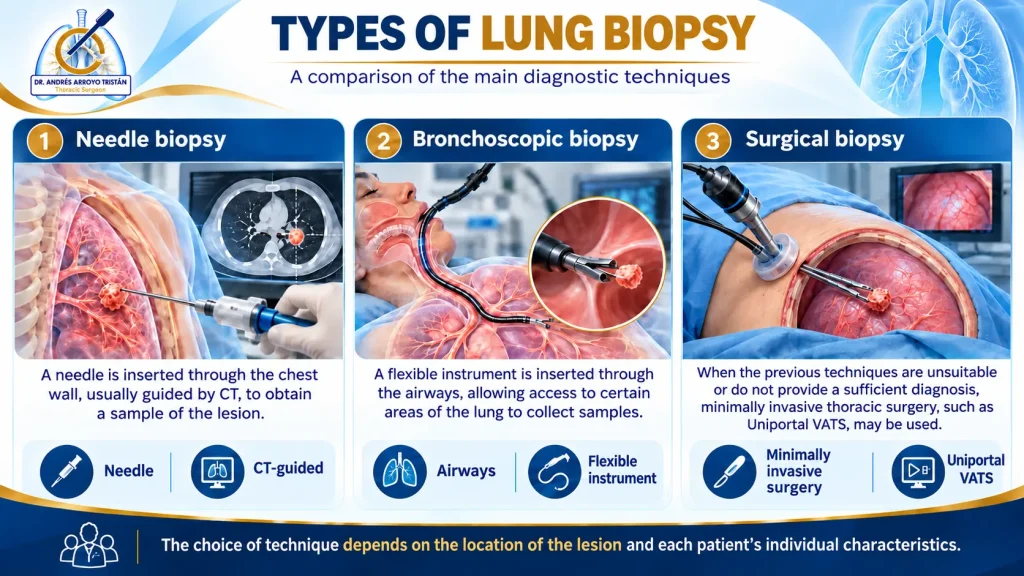
There are different techniques for obtaining a lung tissue sample. The choice mainly depends on the location of the lesion and the patient’s characteristics.
Needle biopsy: A needle is inserted through the chest wall, usually guided by a CT scan, to obtain a sample of the lesion.
Bronchoscopic biopsy: A flexible instrument is inserted through the airways, allowing access to certain areas of the lung to collect tissue samples.
Surgical biopsy: When previous techniques are not suitable or do not provide a sufficient diagnosis, we can turn to minimally invasive thoracic surgery, such as Uniportal VATS. Its benefits include less postoperative pain, improved mobility, a shorter hospital stay, earlier discharge and a quicker return to independent daily activities.
Each procedure has specific indications and risks that must be assessed before making a decision.
Is a Biopsy Always Necessary Before Surgery?
Not necessarily.
In certain situations, when a lung lesion shows highly suspicious characteristics, it may be appropriate to proceed directly with surgical resection without performing a biopsy beforehand.
This is particularly the case when the lesion can be removed and the patient is fit enough to tolerate the procedure.
In these cases, surgery can serve a dual purpose: providing a definitive diagnosis and, at the same time, treating the lesion.
Therefore, we should not consider a biopsy a mandatory step for every patient, but rather a tool that we use when it provides essential information for clinical decision-making.
The Importance of a Specialist Assessment
When a lung lesion is detected, the aim is not to perform as many tests as possible, but to select those that will allow us to reach an accurate diagnosis and establish the most appropriate treatment strategy.
As a thoracic surgeon, I consider it essential to assess each case individually, taking into account imaging results, the patient’s clinical condition, and the different diagnostic and surgical options available.
If you have been diagnosed with a lung nodule or lesion and need a specialist assessment, you can schedule a consultation to discuss your case.
Dr. Andrés Arroyo Tristán
Specialist in Thoracic Surgery.
For more information or to book a consultation, visit www.andresarroyotristan.com.
This article is for informational purposes only and does not replace an individual assessment by your medical team.